Architecture

How Jungle Grid works

Send an AI workload from your app, agent, API, or CLI. Jungle Grid finds suitable capacity, runs the job, and gives you status, logs, outputs, and artifacts through one consistent workflow.

Read the docsSee pricing
Step 1
Submit
Send the workload from your app, agent, API, or CLI.
Step 2
Run
Jungle Grid finds suitable capacity and starts the job.
Step 3
Get results
Track status, read logs, and retrieve outputs or artifacts.

Workload path

From one request to a completed AI job

Start by describing the work you want to run. Jungle Grid accepts the job, finds suitable capacity, and manages the execution without exposing provider-specific infrastructure to your application.

The job moves through a clear lifecycle from queued to running to completed or failed. You can follow that lifecycle, inspect logs, and collect generated files or other output through the API, MCP tools, CLI, or portal.

See it run

Watch a request become a completed job

The Claude demo shows an agent turning a natural-language request into a real GPU-backed job without choosing infrastructure first.

The CLI demo shows the same workflow from the terminal: describe the workload, submit it, and let Jungle Grid handle where it runs.

Activepieces workflow demoReady Paths · Workflow automation

31 Seconds. Zero GPU Setup. One Completed AI Job.

See a real AI workload run from an Activepieces workflow through Jungle Grid Ready Paths — from trigger to completed result in 31 seconds, without manually provisioning or selecting GPUs.
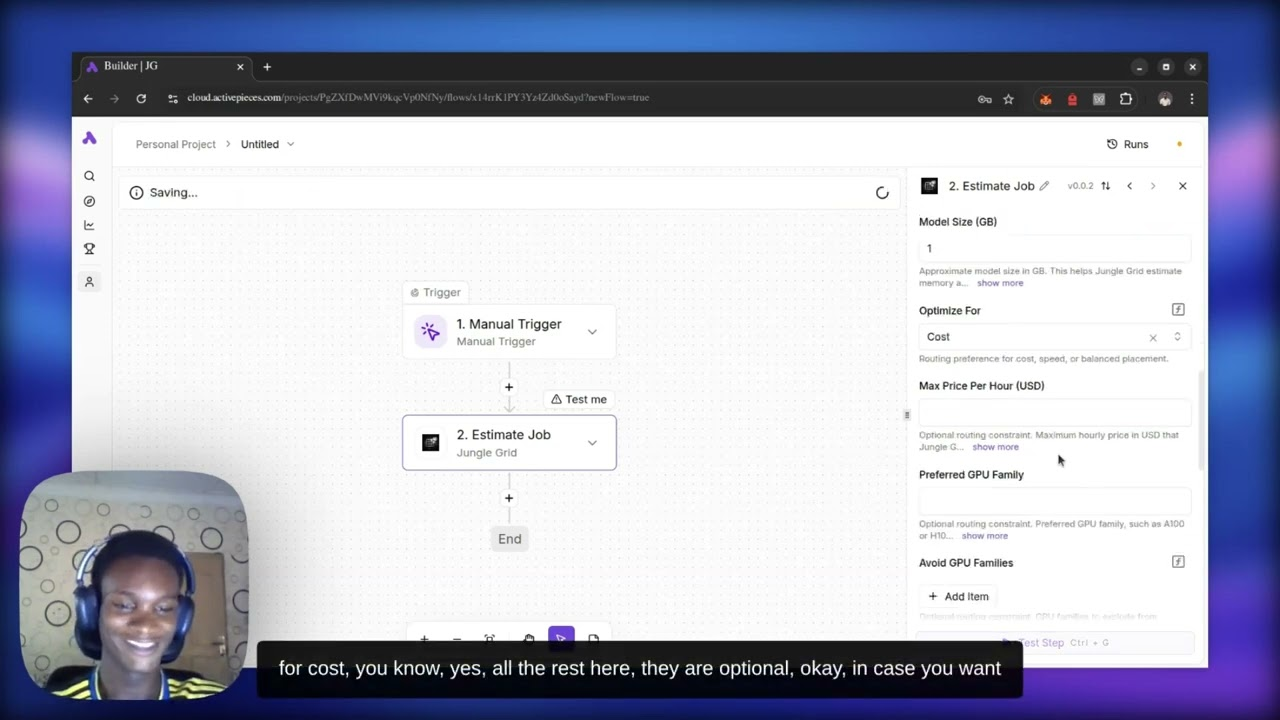
Shows: Activepieces workflow → Jungle Grid execution → completed workloadWatch on YouTube
Claude demoNatural language to GPU execution

Describe a Workload in Claude → It Runs on GPUs

A Claude-driven workflow where a natural-language workload request becomes a real GPU-backed execution path through Jungle Grid.

Shows: Agent-led workload execution from ClaudeWatch on YouTube
CLI demoIntent-first terminal submit

Stop Choosing GPUs. Just Run the Workload (CLI Demo)

A straight operator flow in the terminal: describe the workload, submit by intent, and let Jungle Grid place the run on compatible GPU capacity.

Shows: Operator-first submission through the CLIWatch on YouTube

What Jungle Grid handles

One workflow across changing infrastructure

Your integration stays focused on the job. Jungle Grid handles placement, execution, lifecycle tracking, and supported recovery behavior behind a consistent interface, even when the available infrastructure changes.

  • Submit inference, training, fine-tuning, batch, and containerized jobs
  • Track queued, running, completed, and failed states
  • Read logs and retrieve outputs or artifacts without opening a provider console

Why this matters

Your application should manage jobs, not GPU providers

Connecting directly to GPU providers can push provisioning, routing, status handling, and recovery logic into your application. Jungle Grid keeps those infrastructure concerns behind one execution interface so your team can focus on the work and its result.

What to do next

Choose the next step for your workload

Estimate the cost of your workload, check model requirements, or compare Jungle Grid with another platform. When you are ready to build, the docs show how to submit and track your first job.

FAQ

Frequently asked

What is the basic Jungle Grid workflow?

You submit an AI workload from your app, agent, API, or CLI. Jungle Grid finds suitable capacity and runs the job. You can then track its status, read logs, and retrieve outputs or artifacts through the same workflow.

Why does this architecture matter?

Your application can use one job workflow without taking on provider selection, GPU provisioning, or separate infrastructure integrations for every run.

What should I read next?

If you want implementation detail, go to the docs. If you want to compare options, visit the comparison pages. If you want to estimate spend, go to pricing.